
Fleetly Planning & Dispatch
Fleet route planning and dispatch connected to live execution.
Build routes, allocate drivers and vehicles, send work to the road and compare planned activity with actual progress.
- Configured around your vehicles, drivers and operation
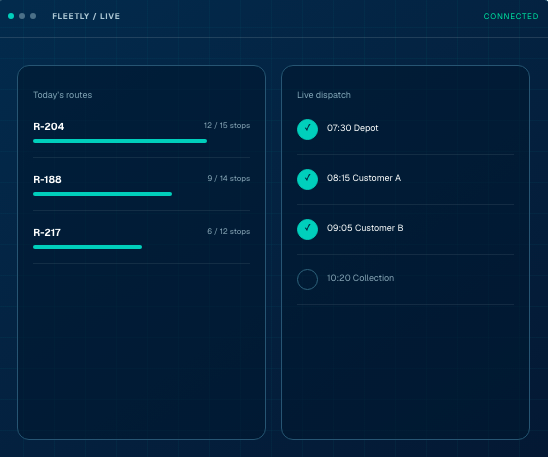
- Multi-stop route planning
- Driver and vehicle allocation
- Live progress and exceptions
Connected by design
Create a plan the operation can actually execute
Fleetly brings orders, locations, time requirements, driver availability and vehicle context into the planning process. Routes can be prepared and released to the Fleetly Driver App with the information needed for each stop or job.
Once work begins, connected tracking and status updates show actual progress. Dispatchers can focus on delays, missed milestones and new priorities rather than repeatedly asking drivers for updates.
Core capabilities
Everything needed to move from insight to action.
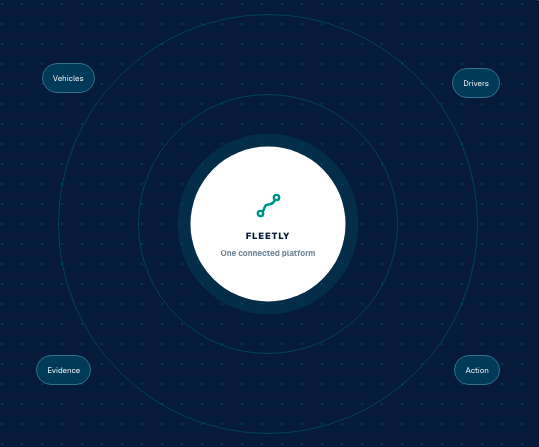
Each capability works with the wider Fleetly platform, keeping vehicles, drivers, events, evidence and outcomes connected.
01
Order intake
Create or integrate jobs with customer, location, timing and service details.
02
Route building
Organise work into practical multi-stop routes and sequences.
03
Resource allocation
Assign suitable vehicles and drivers using relevant availability and compliance context.
04
Driver dispatch
Send routes, instructions and updates to the Fleetly Driver App.
05
Live control
Compare route progress, status and tracking with the planned operation.
06
Performance review
Analyse planned versus actual time, distance, completion and exceptions.
Fleetly connected capability
Connect the planning desk, the driver and the live fleet
This capability works inside Fleetly One Platform, sharing the same vehicles, drivers, events, workflows and reporting as the wider fleet operation.
01
Reduce manual coordination
02
Protect customer commitments
03
Respond to exceptions earlier
04
Improve future route plans
How it works
A clear path from connection to improvement.
Fleetly makes sophisticated fleet technology usable by connecting each signal to a decision, an owner and an outcome.
Built for operational reality
Route planning within the wider fleet picture
Fleetly can surface relevant vehicle, driver, maintenance or compliance context during allocation. This helps planners avoid creating a good route with an unsuitable resource.
Exact optimisation constraints and integration scope are agreed around the customer’s operating model and data availability.
Open by design
Integrate compatible devices and systems without closing future options.
Role-relevant
Give managers, drivers and specialist teams the experience they actually need.
Accountable workflows
Retain decisions, ownership, evidence and outcomes in one operational history.
Frequently asked questions
Clear answers for a
confident fleet
decision.
Talk to Fleetly for a solution assessment based on your vehicles, devices, operating model and required outcomes.
Can Fleetly plan multi-stop routes?
Yes. Fleetly Operations can organise orders or jobs into routes and dispatch them to drivers.
Can routes be sent to drivers?
Yes. The Fleetly Driver App can receive assigned work, instructions and updates.
Can dispatchers see live progress?
Yes. Connected tracking and job status provide a live operational view.
Can Fleetly import orders?
Orders may be imported or integrated depending on the source system and agreed implementation.
Can Fleetly compare planned and actual performance?
Yes. Fleetly can retain plan and execution data for operational review.
Continue exploring
Connected Fleetly solutions and capabilities.
Follow the closest customer journey or return to Fleetly One Platform to see how every part works together.
FLEETLY
Fleetly Operations
Plan orders, build routes, dispatch work and capture progress through one operational view and a purposeful Fleetly Driver App.
FLEETLY
Fleetly Tracking
See vehicles, assets, drivers and routes in context with live maps, accurate journey history, time-range replay, geofences and actionable alerts.
FLEETLY
Driver Identification
Use supported Driver ID and Visual ID methods to improve attribution across tracking, safety, compliance and operations.