
Rail (Train)
Connect rail asset context with the teams responsible for it.
Explore operational visibility, condition-data integration and evidence workflows for rolling stock, depot assets and supporting road fleets through a rail-specific assessment.
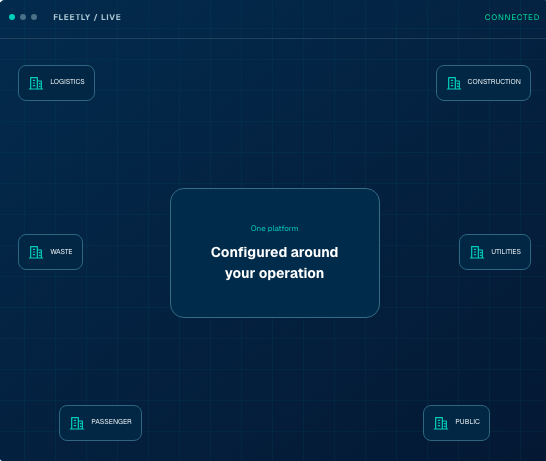
- Configured around your vehicles, drivers and operation
- Locomotives & trainsets
- Wagons & rail assets
- Depot support vehicles
- Road & rail maintenance fleets
Rolling stock and supporting fleets
The right context changes the decision.
Rail operations combine assets with different identities, service requirements and approval processes. Fleetly’s role should be defined around supplementary fleet information and workflow integration. Any connection to rolling stock or railway infrastructure needs the operator’s engineering review, data permissions and applicable acceptance process before deployment.
CONNECT WHAT MATTERS
Fleet capabilities with a clear operational purpose.
Build a solution around the data you can trust and the actions your teams need to take.
01
Asset identity and context
Design a consistent model for locomotives, vehicles, trainsets or wagons, retaining the identifiers used by existing rail systems.
02
Condition-data integration
Assess permitted interfaces for available equipment condition and maintenance signals without assuming access to train control networks.
03
Evidence and investigation
Bring compatible event or video records into an authorised review with reliable time and asset association.
04
Supporting road fleets
Apply established vehicle tracking, safety and maintenance workflows to road vehicles serving rail operations.
THE OPERATIONAL WORKFLOW
A clear boundary between insight and rail control.
Supplementary information flows to the responsible team. Operational authority remains with approved railway systems and procedures.
01
Register the asset
02
Connect approved data
03
Review condition & events
04
Plan depot action
MEASURE WITH CONFIDENCE
Define success before you start.
Use a representative baseline and comparable operating periods. These are suggested measures, not claims of achieved customer results.
FROM ASSESSMENT TO OPERATION
Start with a deployment that fits.
Agree equipment, data ownership and acceptance criteria before scaling. A representative pilot should prove the complete workflow, including exceptions and handover.
Fleetly is not a signalling, interlocking, train-protection or movement-authority system. GNSS position must not be used to determine track occupancy or authorise train movement. Rail deployment and integrations are subject to feasibility and applicable approvals.
Capabilities depend on supported devices, approved integrations, available data and enabled modules. Confirm the production scope during solution design.
Agree the use case with the rail operator and responsible engineering team first.
Validate electrical, environmental, installation and interface requirements for the specific asset.
Keep location uncertainty, tunnels, data delays and changing asset formations explicit.
COMMON QUESTIONS
Clear answers for your industry.
Is Fleetly a train-control system?
No. The proposed scope is supplementary fleet visibility, evidence and workflow integration, not safety-critical train control.
Can standard road cameras be installed on trains?
Do not assume suitability. Hardware, installation and interfaces need asset-specific engineering assessment and applicable approvals.
Can we include the road fleet that supports rail operations?
Compatible road vehicles can be assessed for Fleetly’s vehicle tracking, video and maintenance workflows alongside a separately defined rail asset scope.
KEEP EXPLORING
Practical resources for your next step.
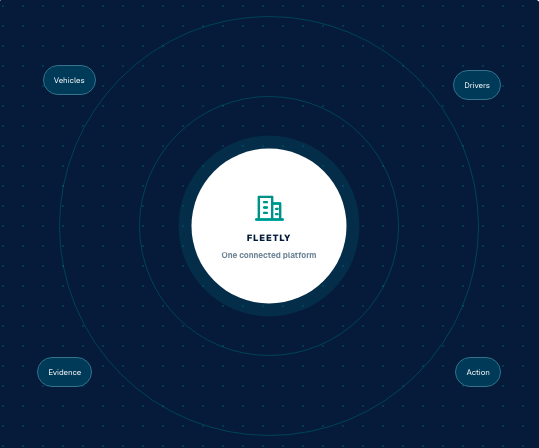
Follow the closest customer journey or return to Fleetly One Platform to see how every part works together.
Documentation
Fleet data and identity reference
Core entities and relationships for an integration discovery workshop.
Guide
The connected fleet rollout workbook
Plan a controlled rollout from inventory to operational handover.
FLEETLY FOR RAIL (TRAIN)
Build a clearer picture of your operation.
Discuss your fleet, existing technology and the decisions you want to improve.